
Virtuous Nonsense
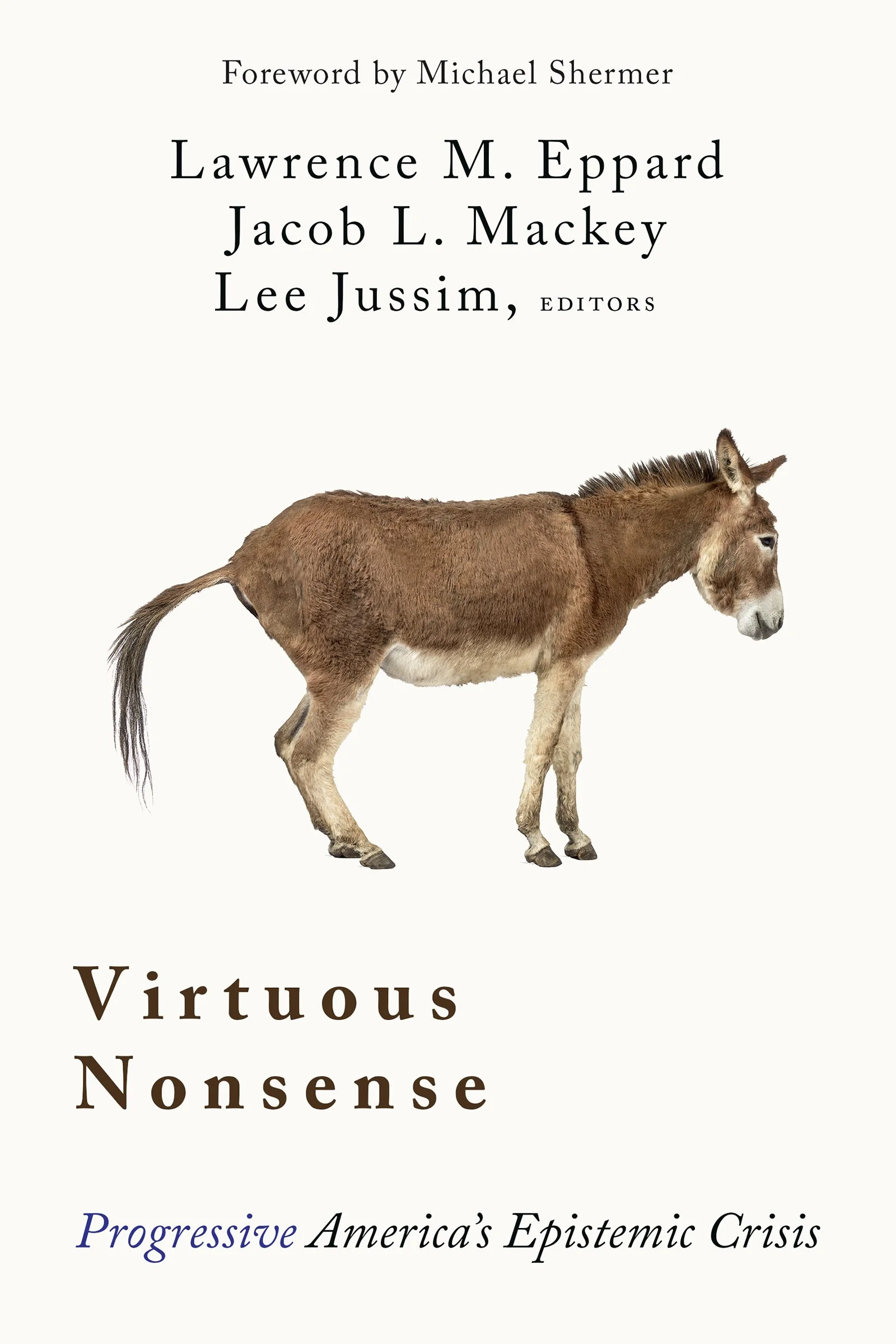
Virtuous Nonsense
"Virtuous Nonsense is where shibboleths go to die. Wide-ranging, bracing, and engaging, this collection of essays is a one-stop shop for understanding today’s attacks on truth and liberal democracy. If you care about the integrity of science and the reputation of academia—and we all should—this is a book to read, ponder, and give."
——Jonathan Rauch, senior fellow, Brookings Institution, and author of The Constitution of Knowledge
About the Book
Many American liberals believe that misinformation is just a right-wing problem. As a result, they ignore a similar crisis of misinformation occurring on the left—particularly within higher education—and reflexively dismiss any such claim as just another right-wing talking point. Yet, as Virtuous Nonsense makes clear, the epistemic problems in blue America are not only real but also worsening and can no longer be ignored. With contributions from a wide range of liberal-minded scholars and thinkers, including Musa al-Gharbi, Jonathan Haidt, Carol Tavris, and Matthew Yglesias, among many others, the volume demonstrates how large segments of the academy—namely, in the social sciences, the humanities, and education—have become captive to progressive ideology.
Where universities once sought to produce and disseminate reliable knowledge, far too many academics today prioritize activism and political projects. This results in poorly supported academic theories and distorted claims that eventually proliferate beyond the university—through the graduation of students who’ve received a flawed education, through a mainstream media that all too often credulously parrots even the most biased claims as “the truth,” and ultimately through public institutions increasingly shaped by politicized expertise.
On subjects ranging from race and gender to single parenthood and free markets, Virtuous Nonsense exposes the most damaging of these academic distortions, which not only undermine public trust and sound policymaking but also artificially narrow the boundaries of acceptable debate. In so doing, it presents a challenge to the left: face the crisis, or remain complicit in the degradation of our intellectual and civic life. Until more liberals acknowledge the problem of malfunctioning disciplines and uncritical media environments, America cannot hope to repair its engines of knowledge—or recover from an epistemic crisis that sickens our culture, society, and politics.
About the Editors
Lawrence M. Eppard is an Associate Professor of Sociology at Shippensburg University and Director of the Connors Institute for Nonpartisan Research and Civic Engagement. He specializes in economic and racial inequalities, poverty and social welfare, and modern American epistemological dysfunctions. He lives in Pennsylvania.
Jacob L. Mackey is an Associate Professor of Classics at Occidental College. He specializes in Greek and Latin languages and literature, ancient religions, ancient childhood, and approaches to ancient cultures that are informed by the cognitive sciences. He is a co-founder of the non-profit organization Free Black Thought. He lives in California.
Lee Jussim is a Distinguished Professor of Psychology at Rutgers University. He specializes in social psychology broadly and social perception specifically—the study of how people perceive, think about, and judge others. He lives in New Jersey.
Michael Shermer (foreword by) is executive director of the Skeptics Society and founding publisher of Skeptic magazine.
Details
ISBN: 9781634312905
Format: paperback
SRP: $27.95
Page count: 472 pages
Trim size: 6 x 9
Pub date: October 2026
Related Titles


About the Book
In Against the New Politics of Identity, philosopher Ronald A. Lindsay offers a sustained criticism of the far-reaching cultural transformation occurring across much of the West by which individuals are defined primarily by their group identity, such as race, ethnicity, gender identity, and sexual orientation. Driven largely by the political Left, this transformation has led to the wholesale grouping of individuals into oppressed and oppressor classes in both theory and practice. He warns that the push for identity politics on the Left predictably elicits a parallel reaction from the Right, including the Right’s own version of identity politics in the form of Christian nationalism. As Lindsay makes clear, the symbiotic relationship that has formed between these two political poles risks producing even deeper threats to Enlightenment values and Western democracy. If we are to preserve a liberal democracy in which the rights of individuals are respected, he concludes, the dogmas of identity politics must be challenged and refuted. Against the New Politics of Identity offers a principled path for doing so.
About the Author
Ronald A. Lindsay is former president and CEO of the Center for Inquiry and of its affiliates, the Council for Secular Humanism and the Committee for Skeptical Inquiry. He has a PhD in philosophy from Georgetown University, with a concentration in bioethics, and a JD from the University of Virginia. He lives in Northern Virginia.
Details
ISBN: 9781634312448
Format: paperback
SRP: $19.95
Page count: 280 pages
Trim size: 6 x 9
Pub date: November 2023